
The battered rupee gained 225 paise to 66.55 against the dollar today, the most in at least 15 years, after the Reserve Bank of India eased pressure in the currency market by starting a facility for state-run oil refiners to buy foreign exchange.

"The issue in Iraq is still an area of uncertainty.

The rupee appreciated 7 paise to 79.74 against the US dollar in early trade on Thursday as a positive trend in domestic equities supported the local unit. However, a strong American currency overseas and forex outflows restricted the rupee's gain, dealers said. At the interbank foreign exchange, the rupee opened at 79.72 against the American dollar, then went lower to trade at 79.74 against the greenback in early deals, registering a gain of 7 paise over the last close.

Inflows of hot money or short-term funds by way of non-resident Indian deposits are not expected

India's macroeconomic fundamentals are strong to deal with global challenges and the central government is committed to sticking to the fiscal deficit target of 6.4 per cent of the GDP for the current fiscal, official sources said on Monday. The government is taking steps to deal with the spiralling crude oil prices in the international market, the sources said. India meets nearly 85 per cent of its oil demand through imports and a weaker rupee makes imports costlier.

Bank of America (BofA) Securities expects India to be the third-largest economy in the world by 2031. The economic rise could become a reality by 2028, but the Covid pandemic delayed the pace, BofA Securities economists Indranil Sen Gupta and Aastha Gudwani wrote in a report.
India's top financial bureaucrat denied on Monday that the government was seeking dollar loans to repay some of its offshore debt.

'When the gold price rises rapidly, India's physical gold market remains on standby.'

The Reserve Bank of India (RBI) will have to take far more pro-active steps to rebuild forex reserves, because if the status quo remains, rupee could touch 75 per US dollar by the end of 2014, Bank of America Merrill Lynch said in a report.

The current account deficit widened to $10.1 billion or 2.1 per cent of GDP for the September quarter as against 1.2 per cent in the year-ago period.

Foreign banks and private credit funds are queuing up to fund acquisitions by Indian companies who are buying out their local rivals. The Adani Group, Torrent Group, and the Hindujas have approached several foreign banks and private equity (PE) firms to fund their acquisitions. Global investors have about $2 trillion of funds to invest, and about $100 to $150 billion is set aside for India, according to an estimate by JP Morgan.

The Reserve Bank of India on Friday decided to leave benchmark interest rate unchanged at 4 per cent but maintained an accommodative stance as the economy faces heat of the second Covid wave.

Overseas investors have pulled out a net Rs 1,14,855.97 crore from the Indian markets in the current year so far, amid heightened geopolitical tensions and inflation concerns. Foreign portfolio investors have sold domestic equities worth Rs 48,261.65 crore so far this month, taking the year-to-date tally this year to a massive Rs 114,855.97 crore, according to depositories data. The exodus of foreign investors was largely owing to inflationary pressures and deepening global macroeconomic conditions following the Russia-Ukraine war, experts said.

Exchange-traded currency derivatives volumes are likely to drop in view of new Reserve Bank of India (RBI) rules, casting a cloud over further participation of retail investors and proprietary traders. There are concerns that existing positions without any underlying exposure will need to be liquidated. Also, weighed down by dollar demand from local oil companies and weakness in its Asian peers, the rupee on Wednesday (April 3) ended at a new closing low of 83.44 versus the US currency.

India's current account deficit is expected to deteriorate in the current fiscal on account of costlier imports and tepid merchandise exports, according to the Finance Ministry's monthly economic review. The review released on Thursday by the ministry also said that global headwinds would continue to pose a downside risk to growth as crude oil and edibles, which have driven inflation in India, remain major imported components in the consumption basket. For the present, it said, "their global prices have softened, as fears of recession have dampened prices somewhat. This would weaken inflationary pressures in India and rein in inflation."

For the banking system a new cycle starts in FY2024. It's fraught with fresh challenges on asset quality and profitability, warns Tamal Bandyopadhyay.
Since the start of the year, the RBI has had to contend with rising inflation and increased liquidity in the financial system causing it to raise CRR and repo rate to reign in the excess money.

There has been a stellar rise for the Indian markets this far in calendar year 2021 (CY21) with the S&P BSE Sensex surging over 19 per cent. The gain in mid-and small-cap indices on the BSE has been sharper with both these indexes surging around 38 per cent and 54 per cent, respectively during this period. Rampant spread of Covid pandemic's Delta variant and the ensuing lockdown and mobility curbs across India, rising prices key commodities, including crude oil and its impact on inflation, possibility of tightening of policy stance by major global central banks, especially the US Federal Reserve (US Fed) have been some of the key headwinds that the markets successfully negotiated during this period.
Since end-May there has been volatility in the foreign exchange market.
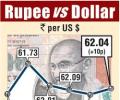
The currency's relatively stable performance even as the US announced tapering showed India's better preparedness to deal with any fallout of such foreign fund outflows.

'Valuations are very attractive, and most companies are cash-rich with strong dividend yields.'

The relentless rise of the rupee was partially stemmed on Thursday by the intervention of the Reserve Bank of India (RBI) in foreign exchange markets - possibly the first such instance this year.

Email alarm made government close arbitrage window

It was a year of big gains for equity investors.

A weak US dollar in overseas markets was the main reason for the rupee's rise even as losses in domestic stocks and some fag-end dollar demand from importers prevented further gains

India is facing no risk of recession or stagflation as macroeconomic fundamentals of the economy are strong, Finance Minister Nirmala Sitharaman said on Monday. Replying to a debate on price rise in the Lok Sabha, she said the GST collection and Purchasing Managers' Index (PMI) are indicating that the Indian economy is getting more robust. The GST collection rose 28 per cent to touch the second-highest level of Rs 1.49 lakh crore in July. GST, introduced in July 2017, touched a record high of Rs 1.68 lakh crore in April 2022.

The currency market won't care for our moans, groans, cries and sighs. The rupee will find its own level, explains Tamal Bandyopadhyay.

Continuing its range-bound movement for the fourth session, the rupee today closed up by two paise at 59.25 ahead of industrial output and retail inflation data.

At the Interbank Foreign Exchange (Forex) market, the domestic unit opened lower at 56.02 as against its previous close of 55.64 on dollar buying by importers, mainly oil refiners, to meet their month-end requirements.

The union government is expected to cut two per cent import duty in gold in the forthcoming budget, as local jewellers run out of inventory, a leading US brokerage said.

The dollar-rupee rate could move in the opposite direction if dollar policy rates rise and the FPIs sell in December, says Devangshu Datta.

For the first time, the rupee declined to the low level of 80 against the US dollar in intra-day spot trading on Monday before ending the session 16 paise lower at 79.98 amid a surge in crude oil prices and unrelenting foreign fund outflows. At the interbank forex market, the local unit opened at 79.76 against the greenback but lost ground to touch the psychological low mark of 80 against the American currency. The local unit clawed back some lost ground and closed at 79.98, registering a fall of 16 paise over its previous close.

US brokerage Bank of America-Merrill Lynch on Tuesday said its sees the first rate cut this fiscal only in March next as inflation is expected to fall only by December end on a decline in commodity prices driven by the US Fed tapering.

'You can put 25 per cent right now; put another 25 per cent when Nifty corrects another 500 points.' 'At 13,500 put another 25 per cent and at 13,000 one can get fully deployed.'

The rupee appreciated by 0.27 per cent in June against the dollar.

The Congress released a booklet 'Nau saal, Nau sawaal', asking nine questions from Modi. The BJP rejected the Congress' criticism as a 'bundle of lies and mountain of deception' and said the questions are born out of 'pathological hatred' of the PM.

Already retail inflation has risen to 6.07 per cent in February, crossing the upper band of the Parliamentary mandate. This is the second consecutive month in 2022 when retail inflation has crossed the 6 per cent mark having hit 6.01 per cent in January.

The year 2015 may well turn out to be a watershed in global macroeconomic adjustment.

China will use airpower to support Pakistan from the start of a war. China will use the opportunity to at least take Ladakh. Its growing navy will prevent India from blockading or attacking the Makran Coast. And thanks to Chinese weapons, Pakistan keeps expanding its forces, observes Ravi Rikhye.
 © 2026 Rediff.com - Investor Information - Advertise with us - Disclaimer - Privacy Policy - Sitemap - Feedback - About us - Terms of use - Grievances